Booking the trip from Tunis
Dougga day trip from Tunis: how to book
What the private Dougga and Bulla Regia tour includes, what it leaves out, and when to drive, hire a driver or take a louage instead, with no guesswork.
See Dougga tours on GetYourGuide ↗Quick answer
The simplest way from Tunis is a private day trip covering Dougga and Bulla Regia in about eight hours, with hotel pick-up in Tunis or Hammamet, a guide on site, entrance fees for both sites and an air-conditioned private car. Lunch and tips are extra. If you have your own car or a driver and like to plan, going independently also works: Dougga is about 106 km south-west of Tunis, and there is no simple train.
Three ways to reach Dougga
| Private tour | Car or driver | Louage or bus | |
|---|---|---|---|
| Transport | Private car, hotel pick-up | Yours, or hired | Shared, then local taxi |
| Guide | On site, included | Hire separately | Hire separately |
| Entrances | Both sites included | Paid at the gates | Paid at the gates |
| Bulla Regia | Same day, built in | You plan it | Extra transfers |
| Best for | First visit, full day | Your own timing | Patient planners |
What the private tour covers
The tour collects you from your hotel or another pick-up point in Tunis or Hammamet and drives to Dougga first. The visit starts at the Roman theatre, then moves through the residential quarter past temples and the large Licinian Baths, with good photo spots near the Capitol. After that the car continues to Bulla Regia to see its underground villas, with an optional lunch before the drive back. The whole day takes about eight hours, and the booking calendar shows the start times. It is a private group, not a shared coach, and guides work in English, French or Arabic.
- Pick-up and drop-off at your hotel or location in Tunis or Hammamet
- Transport by air-conditioned private car
- Local guides at the sites
- Entrance fees for Dougga and Bulla Regia
Read next: Dougga visit guide: what to see and how long
What you will see at Dougga
Dougga was listed by UNESCO in December 1997 and is described as the best-preserved Roman small town in North Africa. It began as a Numidian settlement no later than the end of the 6th century BC, passed to Rome after 46 BC, became a municipality in AD 205 and a Roman colony in AD 261. Only about a third of the site has been excavated, and it has produced more than 2,000 inscriptions in Libyc, Punic, Neo-Punic, Greek and Latin. On a tour you cover the theatre, the Capitol, the baths and the residential quarter, with a guide to tell you which building is which.
What is not included
Lunch is not included. The day has an optional lunch stop in Dougga, and you pay for your own meal. Gratuities are optional and also extra. Pick-up and drop-off from hotels in other cities is not included either, so if you are staying outside Tunis or Hammamet, check the pick-up details the booking page shows for your date before you reserve. Booked through GetYourGuide, the tour can be cancelled free up to 24 hours ahead, and you can reserve now and pay later, so holding a date costs little while your wider Tunisia plans settle.
Why most visitors take a day trip
Dougga stands on a hilltop plateau about 106 km south-west of Tunis, on the road toward Le Kef, and about 4.6 km from the town of Téboursouk. There is no simple train connection, which is why most visitors either drive or book a tour with transport. Plan on most of a day. The drive from Tunis is usually described as roughly one and a half to two hours each way, depending on traffic, and the tour's eight hours also cover a second site and the time you spend walking both.
Going independently: your options
Independent travel is realistic if you like planning. A rental car or a hired driver gives you the most freedom. Without either, louages (shared taxis) and buses run to towns including Téboursouk, and you then need a local taxi for the last stretch and a plan for getting back. Independent visitors pay the site's entrance fee on arrival, so check current hours and the fee with the site before you set off. You will also need to hire a guide or read up beforehand, because Dougga's layers of history are easy to miss on your own. If you hire a driver, agree the route, the waiting time and the return before you leave, since the last stretch is rural.
- Own car or driver: the most flexible, with the most planning
- Louage or bus to Téboursouk, then a local taxi: possible, but slow and hard to time
- Private tour: transfers, a guide and entrance fees handled for you
Who should go independently
If you have a car, are happy on rural roads and want to spend three hours at Dougga with no schedule, going independently makes sense, and so does a hired driver if you want a flexible day without an itinerary. If you would rather have a guide who joins the ruins into one story, no navigation and both sites in a single day, the private tour is the easier choice. There is no official ticket office to send you to for the tour itself: it is run by a local operator and booked online. Bulla Regia is a smaller, more specialised site than Dougga, so the day naturally divides into one long walk and one shorter one.
Bulla Regia: the second site
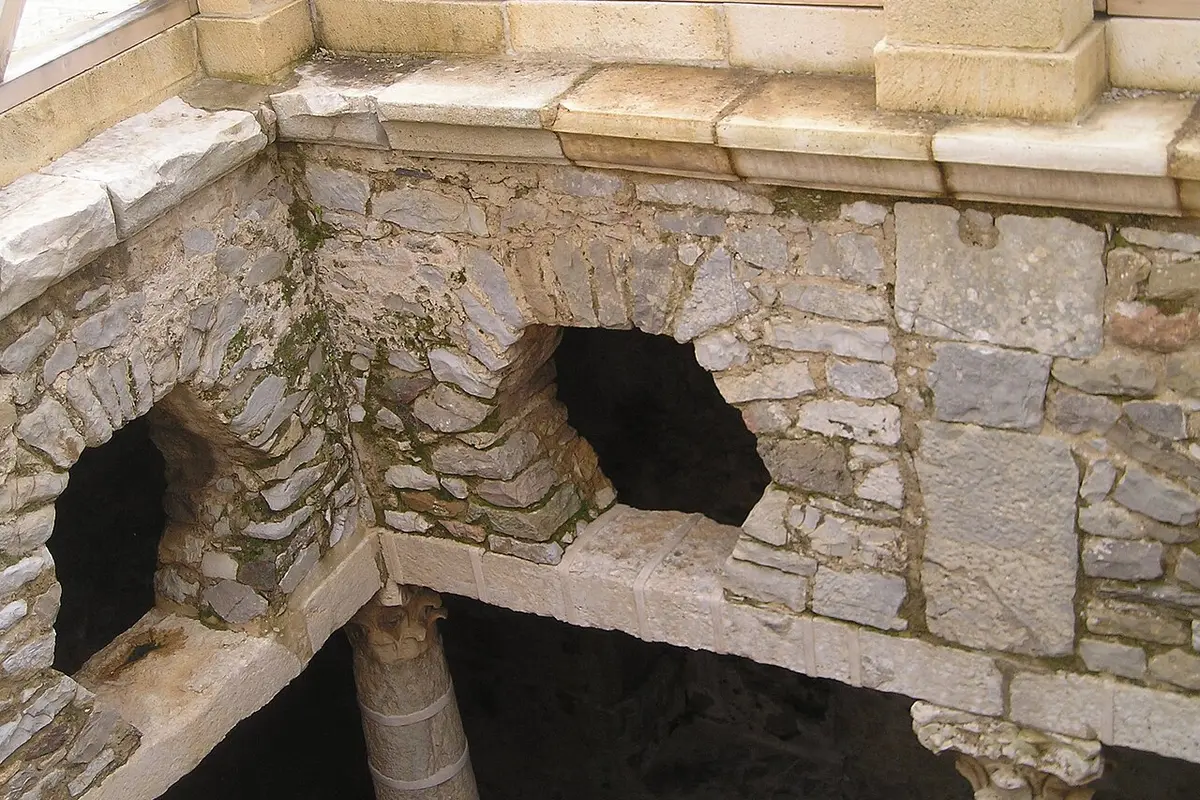
Bulla Regia is known for houses built partly underground. Wealthy residents put living rooms below ground, around a two-storey atrium, to escape the fierce summer heat, and water sprinkled on the mosaic floors cooled the rooms as it evaporated. Named houses include the House of Amphitrite, named for a mosaic of a haloed sea goddess, the House of the Hunt and the House of the Fisherman. Drifting sand covered the abandoned town and helped protect it, and excavation began in 1906. Most mosaics are kept in place, though some are shown at the Bardo Museum in Tunis.
Read next: Dougga vs El Jem, Bulla Regia and Carthage Compared
The Testour question
The tour's name mentions Testour, a town in the Medjerda Valley that was rebuilt in the 1500s by Muslim and Jewish refugees from Andalusia. Its Great Mosque dates to 1631 and has an octagonal minaret about 23 metres tall. The published itinerary, however, centres on Dougga and Bulla Regia with an optional lunch, so if a Testour stop matters to you, ask the operator through the booking before you rely on it.
Choosing your day and what to carry
Dougga has little shade, so the season matters. Spring and autumn are the easiest times to walk the large site. Summer is possible but very hot, so an early start helps. Winter is cooler and greener, but rain and wind can come. Wear comfortable shoes, because the ground is uneven stone, and bring water, a hat and sun protection. The booking calendar shows the start time for each date, and a morning departure is the better fit with the heat. The day is long, so eat breakfast before pick-up and carry some small change for the optional lunch and any tip.
Who this isn't for
If you want a long, slow day at Dougga alone, the tour splits its eight hours across two sites, so a car of your own suits you better. If you want lunch included, it is not. If you are staying in a city other than Tunis or Hammamet, pick-up is not covered. And if a long day in a car is a problem, note that much of the eight hours is spent on the road.
Frequently asked questions
How far is Dougga from Tunis?
About 106 km south-west of Tunis. By car, the drive is usually described as roughly one and a half to two hours each way, depending on traffic. The private tour linked here is an eight-hour day that also visits Bulla Regia.
Is lunch included in the Dougga tour?
No. The tour has an optional lunch stop, and you pay for your own meal. Gratuities are optional and also extra. Entrance fees for Dougga and Bulla Regia are included.
Can I reach Dougga by train or public transport?
There is no simple train connection. Louages and buses run to towns such as Téboursouk, about 4.6 km from the site, and then you need a local taxi and a plan for the return. Most visitors drive or take a tour.
Can I cancel the tour?
Yes. Booked through GetYourGuide, you can cancel up to 24 hours before the start for a full refund. You can also reserve now and pay later, so a date can be held while your plans settle.
Which languages do the guides speak?
English, French and Arabic. The tour is a private group, not a shared coach.
Is Dougga worth a full day?
For Roman history, yes. UNESCO listed it in 1997 as the best-preserved Roman small town in North Africa. With Bulla Regia's underground houses, the day gives you two very different sites.
Sources